
Referendum construction - how much can they actually spend?

Updated: Jan 27, 2025
One of the biggest items to hit West Amwell financial news in the past several years was the passage of the school facilities referendum in 2021 by the South Hunterdon Regional School District. The district convinced voters to authorize a $33.4 million school construction project, funded by selling of bonds, to renovate the Lambertville Public School (LPS) and to build a new Middle School at the high school campus. The State is covering several million dollars of the cost for the LPS renovation.
Alas, it appears that the $33.4 million wasn't enough. Let's see what happened.
In April, 2024, the school board approved the new budget for the 2024/2025 school year, the full resolution is available here. The resolution included this new line item: "BE IT FURTHER RESOLVED that the South Hunterdon Regional School District Board of Education will withdraw up to $2,000,000 from Capital Reserve in accordance with N.J.A.C. 6A:23A-14.1(h) to supplement the approved November 2, 2021 referendum of $33,412,000 ....
The additional Capital Reserve funds are needed in addition to the approved $33,412,000 for the capital projects because of increased construction costs needed to complete the South Hunterdon Regional Middle School Project due to unforeseen delays." [emphasis ours].
Put plainly, the board reserved $2,000,000 to spend on the referendum above and beyond the $33.4 million authorized. The resolution claims this was "due to unforeseen delays", which seems questionable given the change orders we have reviewed, but is beside the point. The first problem here is that school boards do not appear to be allowed to arbitrarily add costs to a referendum budget.
The NJ Department of Education has guidance on this for schools. The linked document is the DOE's guidance to schools on how capital reserves are supposed to work, and what is and is not allowed. This document summarizes the situation regarding referendum construction projects by saying "Spending on a capital project approved by referendum is limited to the amount approved by the voters in the referendum question", and "No change order can be approved if it will increase the total cost above the referendum approved amount".
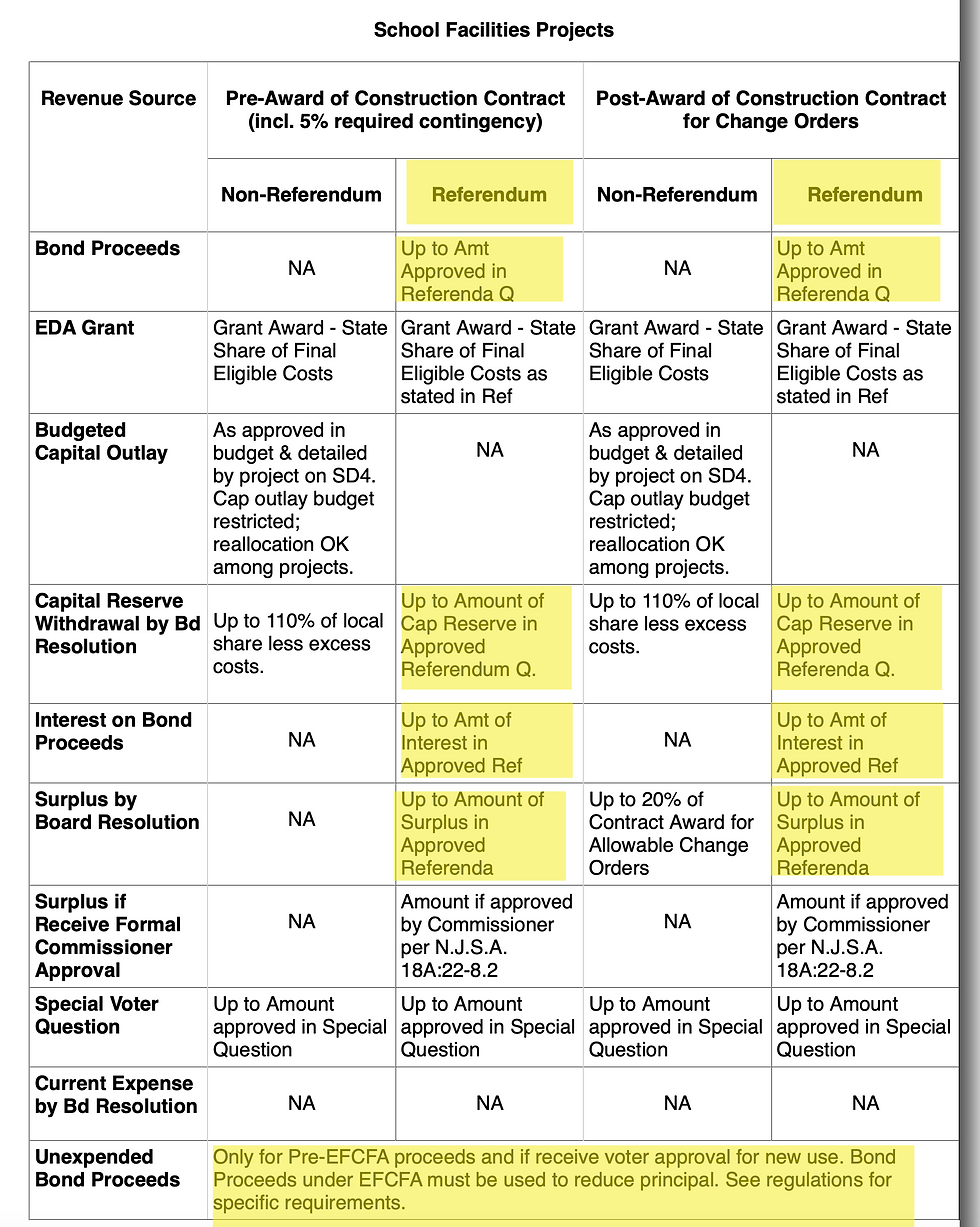
The cited page goes on to provide a matrix of different construction projects and what rules apply to them, shown in this figure below with relevant sections highlighted in yellow.
For reference, here is the 2021 Referendum Question as presented to voters:

Note that the only source of funds mentioned in the referendum question is the $33,412,000, including state funding, and that this is a hard cap.
The School Finance sources are clear that when a referendum is in play, school boards are constrained by the exact question that the voters passed during the election. Specifically, boards cannot arbitrarily spend more money on referendum projects. They are barred from doing so.
Yet South Hunterdon somehow passed a resolution to turn the $33.4 million referendum effectively into a $35.4 million one.
As it turns out, this is also not the whole story. The other question one might ask is, "where did that $2 million extra come from"?
It would appear that the answer to that question is "interest on the $33.4 million". You see, construction of LPS and the Middle School were delayed due to law suits, and the MS site still has pending permits. But the district sold the bonds as soon as they legally could. As a result, they had $33.4 million sitting around, which was invested into an account called NJARM. NJARM is an investment facility created by the State of NJ that allows schools to drop money into (such as the 2021 referendum money) and turn it into an interest bearing account. This earns somewhere on the order of 3%-4% per year. So approximately $31 million sat in the NJARM account earning interest until construction began (for reference, around $2 million was already spent in pre-referendum planning and was deducted from the $33.4 million at the start).
Why are we mentioning this? Because it appears that the $2 million used to "supplement" the referendum came from the bond interest. After the April budget resolution, in September 2024, the following resolution was passed by the Board: "Whereas, The superintendent's recommendation is to transfer of $2,400,000 from the NJ ARM account to the Warrant account, and,
Whereas, the interest earned on the capital projects must go to the general fund as interest income or go to the debt service fund. The superintendent's recommendation is to move these funds to the general fund retroactively as of 6/30/24. This will include any future additional interest less arbitrage".
The same School Finance document referenced above addresses this. "All bond referenda must include and list separately by source, all local revenue to be used on the capital project. This includes such revenue as capital reserve, surplus, and interest earnings. Spending on a referendum approved capital project cannot be increased above the voter approved amount through a transfer of local revenue to the capital projects fund if it was not identified in the original question".
The matrix of construction options we reference above also addresses this, stating "Unexpended bond proceeds under ECFA must be used to reduce principal".
The School board claims that its actions regarding the Interest are legal due to a single clause in NJ State regulations which covers several scenarios simultaneously, including referendum authorized bonds and other bonds not involving referendum, saying it has "discretion" on what to do with the interest. The problem here is that the district is ignoring other laws specific to referendums which state that districts must be held to the literal Question put to the voters, and that districts can't alter that question or its authorizations arbitrarily on its own after voters have spoken.
It is unclear where this stuation leads the district or the remaining MS construction. On its face, the district appears to be illegally expanding the financial scope of the referendum, and is worsening the situation using the NJ ARM interest illegally to fund it.
Beyond the legal ramifications are also the practical ramifications for tax payers. Legal or not, the District had an opportunity to save the tax payers millions of dollars by using the interest to pay down the bond debt. Instead, the district chose to insult tax payers, not pay down their debt, and instead use it to spend even more money on construction.


Comments